
Nebraska Civil Docket Searches
JUSTICE indexes Nebraska civil dockets statewide. It reaches public County and District Court civil cases. A party name or case number is enough to start a docket search. Check the caption, court and county before opening detail. Subscriber filters narrow results by case type, subtype, year, judge and attorney. The one-time service works from a party name alone. The local clerk keeps the file. Any document missing from the index comes from that office.
A Nebraska trial case number starts with a C or D prefix for the court. County, case-type, year and sequence fields follow. Use the court and county shown on the notice to identify the right clerk. Jurisdiction limits can affect the court, though the caption should guide the lookup.
- Open Nebraska Judicial Branch eServices and choose the trial-court case search.
- Select Individual or Entity and enter the party name, or use the Nebraska court case number when known.
- Narrow by county, court type or year only when those details are reliable; compare the case caption before opening detail.
- Read the Nebraska Register of Actions, then open a linked filing or order image if the document is available.
- For the full local file or a certified copy, use Browse Counties to find the originating clerk. The statewide search steps are also set out in Docket Search.
Search Nebraska Civil Cases in JUSTICE
JUSTICE is the Nebraska trial-court case system. The official Nebraska eServices page links to the public search. Subscribers can narrow results by party, court, case type, county, year, judge and attorney. The one-time service searches by name. The help pages are static. They do not list every dynamic subtype or filter value.
The Nebraska District Court overview describes the general-jurisdiction trial court and its clerk. It is a statewide tier, while each local clerk keeps the individual case record.
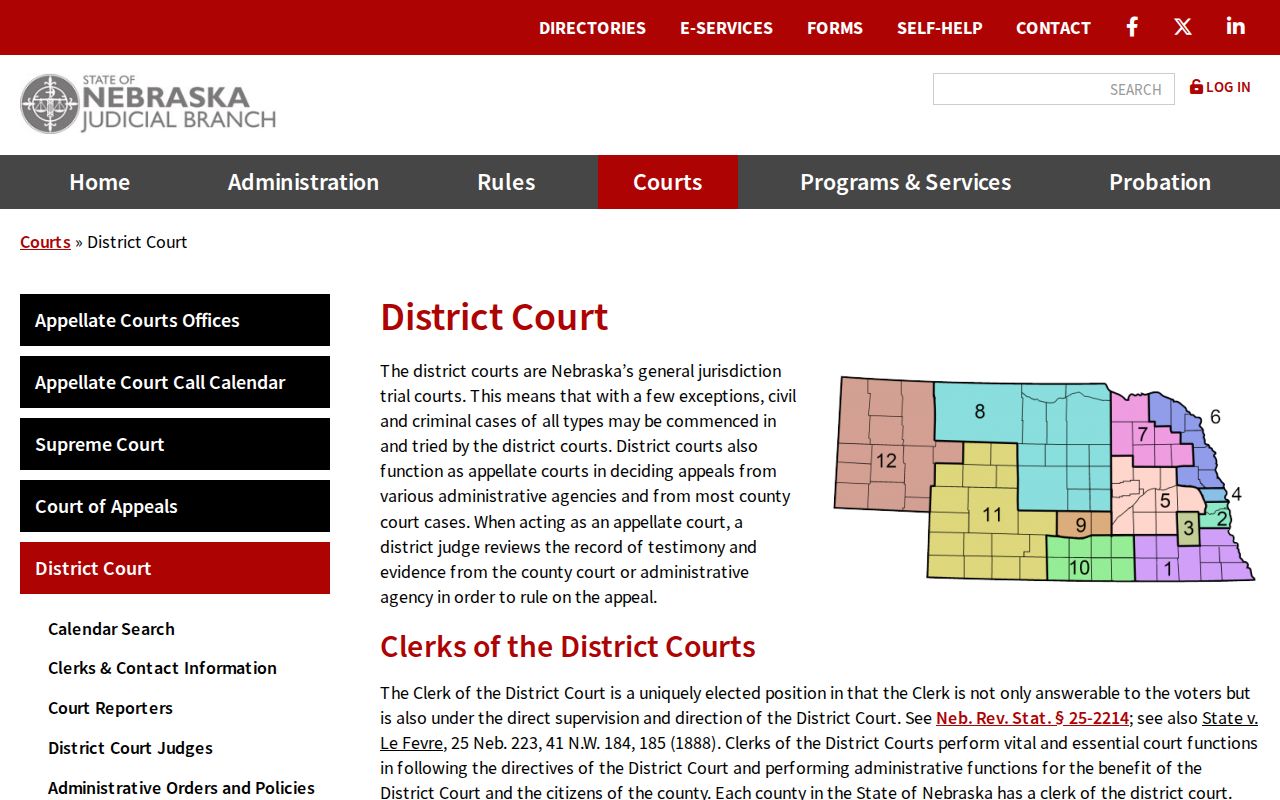
The overview identifies District Court as the civil home for matters beyond County Court jurisdiction. That is its role. The statewide index does not hold every document in the local file.
| Route | What it returns | Access terms |
|---|---|---|
| One-Time Court Case Search | Party-name results, with a maximum of 30 records and three calendar days to access results. | $17 per search. |
| Subscriber trial search | Free general result lists; open a matching case to see the ROA and available images. | $100 annual account fee, up to 10 users; $2 per case detail. |
| Courthouse and law-library terminals | Free public access to Nebraska JUSTICE at participating public terminals. | No online detail charge at the terminal. |
Most Nebraska filings show as images, with no separate image charge in case detail. Result lists update nightly. A missing image can mean an older paper record or a restricted document, not a missing case. The local clerk handles the file and certified copies.
Note: Nebraska search fees buy access to the online service, while clerk copy charges and court filing costs follow separate rules.
Inside a Nebraska Civil Docket
The Register of Actions is the dated list of filings, hearings and orders in a Nebraska civil case. JUSTICE detail follows a shared trial-court shell. Its tabs hold the case summary, parties and attorneys, judgment information, case schedule, financial activity and the ROA. An image link may open the filing itself. An ROA line is only an index entry. It is no substitute for the signed order.
| Case number | The Nebraska trial format starts with C or D, followed by a two-digit county code, case type, year and sequence. A civil pattern example is C## CI-YY-######. |
|---|---|
| Case caption and parties | Shows the named sides and, where displayed, their counsel and party roles in a Nebraska case. |
| Filing and ROA entries | Chronology of complaints or petitions, answers, motions, hearings and orders recorded by the Nebraska court. |
| Case schedule | Current and past settings, which can change when a hearing is continued or reset. |
| Judgment and financial activity | Judgment-related information, costs and payments. The signed judgment supplies the operative terms. |
The Nebraska court guide also lists a Judgment Information tab. It lists an Exhibit List too. Fields, layout and images vary by case. An entry that says an order was entered does not show the full relief granted. Open the linked instrument. Or ask the originating clerk for the signed order or a certified judgment.
Nebraska Civil Court Limits and Filing Volume
Nebraska County Court hears civil claims up to $70,000 through June 30, 2030. Small claims cap at $7,500. Both limits took effect July 1, 2025, as Nebraska's Judicial Branch explains in its jurisdiction update. District Court shares that authority within the statutory threshold. It also handles cases beyond County Court authority. Domestic relations belong there too.
| Nebraska civil route | Scope | Clerk or record cue |
|---|---|---|
| County Court civil in Nebraska | Claims within the $70,000 limit through June 30, 2030. | County Court clerk or clerk magistrate. |
| Nebraska small claims | County Court track with a $7,500 maximum; procedure differs from ordinary civil litigation. | County Court record; a transfer can move a case to its civil docket. |
| Nebraska District Court civil | Claims beyond County Court authority, domestic relations and other general civil matters. | District Court Clerk. |
The Nebraska Judicial Branch FY2025 Annual Report counts 97,373 County Court civil cases. It logs 36,170 total District Court filings. The two figures measure different things. One is a County Court civil category, while the other spans all District Court case types. District 4's 75,076 County Court filings are a district aggregate. They are not a Douglas County civil count.
The Nebraska FY2024 county-court report gives county-level adult-case totals, not civil-only figures. Douglas shows 68,178, Lancaster 46,363 and Sarpy 19,446. District 2's 26,573 spans multiple counties. Keep each number tied to its fiscal year, Nebraska court, case category and geographic unit.
Note: Court statistics describe filings or cases in the report's stated unit; they do not measure pending backlog or the outcome of an individual civil claim.
Nebraska Civil Docket Case Types
Nebraska civil dockets include contract, tort and property claims, domestic relations, probate, guardianship and small claims. The court type and caption identify the clerk. A civil label does not make every document public.
A defendant can transfer a Nebraska small-claims matter to the County Court civil docket by filing written notice at least two days before the hearing and paying a fee. The CC 4:3 form describes the route. The form carries a 2016 revision. Confirm the current fee with the clerk. The transfer changes the case track, not its county or court tier.
Nebraska divorce, custody, probate and guardianship records may include restricted papers or personal details. Check the access status of each item, even when case metadata appears in JUSTICE.
Which Clerk Keeps a Nebraska Civil Docket?
Civil cases split between two clerks in Nebraska. A County Court clerk, sometimes titled clerk magistrate, handles county-court civil, small-claims and probate matters. The District Court Clerk keeps that court's docket and case files. Staffing varies by county. Follow whichever court the record names and use its official contact route.
| Nebraska case record | Nebraska clerk route | What to confirm |
|---|---|---|
| County Court civil and small claims | Nebraska County Court clerk directory | Case number, local copy request process and whether the paper is available electronically. |
| District Court civil or domestic relations | District Court Clerk | Specific filing or signed order, certification, copy cost and delivery method. |
| Appeal from a trial-court judgment | SCCALES and the appellate clerk | Separate appellate number and schedule; the trial docket remains with its original clerk. |
Appeal a Nebraska County Court judgment and the original file stays put. The trial record on appeal can note the notice. It can also note record preparation. SCCALES runs a separate appellate docket with its own case number, briefing and outcome. Federal suits sit outside Nebraska JUSTICE entirely.
Hearings on a Nebraska Civil Docket
A Nebraska civil docket can list a status conference, a motion hearing, mediation, a trial date or another proceeding. Every schedule is case-specific. It shifts as the Nebraska court acts, so trust the newest setting or signed order over an earlier date that has been reset. A continuance only moves a proceeding. It decides nothing and dismisses nothing.
Match the event date and its docket description against any signed order or notice. A financial line may just track costs or payments. The Court Schedule can show a setting, yet the clerk may confirm a later change.
Even a “disposed” case can see more filings. Satisfaction, garnishment and other post-judgment papers may follow.
When a Nebraska Civil Docket Lacks an Image
JUSTICE sometimes shows a Nebraska judgment with no image attached. Write down the event date. Note the exact ROA description too. Nebraska's judiciary says documents filed after April 16, 2008 that qualify may have linked images. Not every later paper was scanned. Older, restricted or paper-only records may require a clerk search.
Call the Nebraska clerk listed on the case. Ask whether the order is electronic, restricted, archived or no longer retained. A search summary is not a certified judgment. Ask for the signed order in the format you actually need. Local clerks can explain inspection, copy and certification options in Nebraska.
Note: The April 2008 image date describes potential image coverage, not a promise that every eligible filing is online.
Civil Docket Access in Nebraska
Many Nebraska civil entries are open to the public. Nebraska court rules, statutes and sealing orders set the bounds. The Nebraska Public Records Act sets a general inspection and copying process. Court-specific rules govern court files. One caution: a visible case summary does not make every document public, and a hidden image does not prove the whole case is sealed.
Nebraska family, juvenile, adoption and other protected records need a closer look. Case data may display while papers or party details stay restricted. Before making a request, ask the clerk which Nebraska rule applies.
Key Rules:
Nebraska Court Rules, Article 8, including Rule 1-808 - sets court-record access channels and excludes information made confidential by law or court order.
Neb. Rev. Stat. § 84-712 - provides public-record inspection and copying rights, subject to specific court-record rules and exemptions.
Neb. Rev. Stat. § 43-113 - protects adoption case records from ordinary public inspection, with authorized statutory access routes.
Neb. Rev. Stat. § 43-2,108 - limits access to confidential juvenile case information and identifies authorized disclosures.
The clerk where a Nebraska case began keeps that file. Send a written request to the wrong office and Nebraska judiciary policy has it forwarded, but forwarding cannot open a sealed item. Rule 1-807 covers compiled court data, not an individual civil file.
Requesting Nebraska Civil Court Copies
Give the Nebraska clerk the court, the county, and the case number. Include the document or event date. Say whether you need a plain or certified copy. Nebraska County Court form CC 3:30 is only an invoice. It is not a universal request form. County Court copy charges run 25 cents per page plus a $1 seal fee under Neb. Rev. Stat. § 33-126.05. District Court works under a separate rule, including Neb. Rev. Stat. § 25-1280.
Ask about estimates, payment, delivery and timing before you visit or mail anything. Public court files can be inspected at the courthouse. JUSTICE access is free at courthouse terminals. Specified library terminals offer it too. Phone, mail and email options vary by county. Written requests still answer to Nebraska court-record rules and cannot unseal a file.
Need a certified trial judgment after an appeal? Contact the originating court. The appeal carries its own docket, but the trial clerk holds the signed judgment.
Note: Specify the paper you need rather than requesting an entire case file when one order or judgment will answer the question.