
How Nebraska Courts Are Organized
Nebraska runs a two-tier trial system under one Supreme Court. A Court of Appeals sits in between. Every one of the 93 Nebraska counties has both a County Court and a District Court. Judges and administration are organized into 12 judicial districts. Only Douglas, Lancaster, and Sarpy Counties have stand-alone Juvenile Courts. In the rest of the state, County Court handles juvenile matters. There is no municipal or justice-of-the-peace tier anywhere in Nebraska.
| Court level | Main work | Case record path |
|---|---|---|
| County Court | Traffic, misdemeanors, small claims, probate, and preliminary felony matters | JUSTICE and the County Court clerk |
| District Court | Felony trials, major civil and domestic-relations cases, and many County Court appeals | JUSTICE and the District Court Clerk |
| Separate Juvenile Court | Juvenile matters in three counties | JUSTICE subject to confidentiality limits; separate court clerk |
| Court of Appeals | Intermediate review of appeals assigned by law or rule | SCCALES and appellate clerk |
| Supreme Court | Highest state court, with appellate and original jurisdiction | SCCALES and appellate clerk |
A felony can travel through both levels. It may start with a County Court preliminary hearing, then move to a District Court docket after bindover.
Nebraska’s Court Administration Office
The Administrative Office of the Courts and Probation serves as the Nebraska Supreme Court's administrative arm. It is known as AOCP or the State Court Administrator's Office. It coordinates court operations, probation services, budgets, and program support across the state. It does not clerk individual Nebraska cases. The Judicial Branch maintains Nebraska's custom-built case systems. Technology administration is assigned to the State Court Administrator's Office. The official administration overview lays out this statewide role.
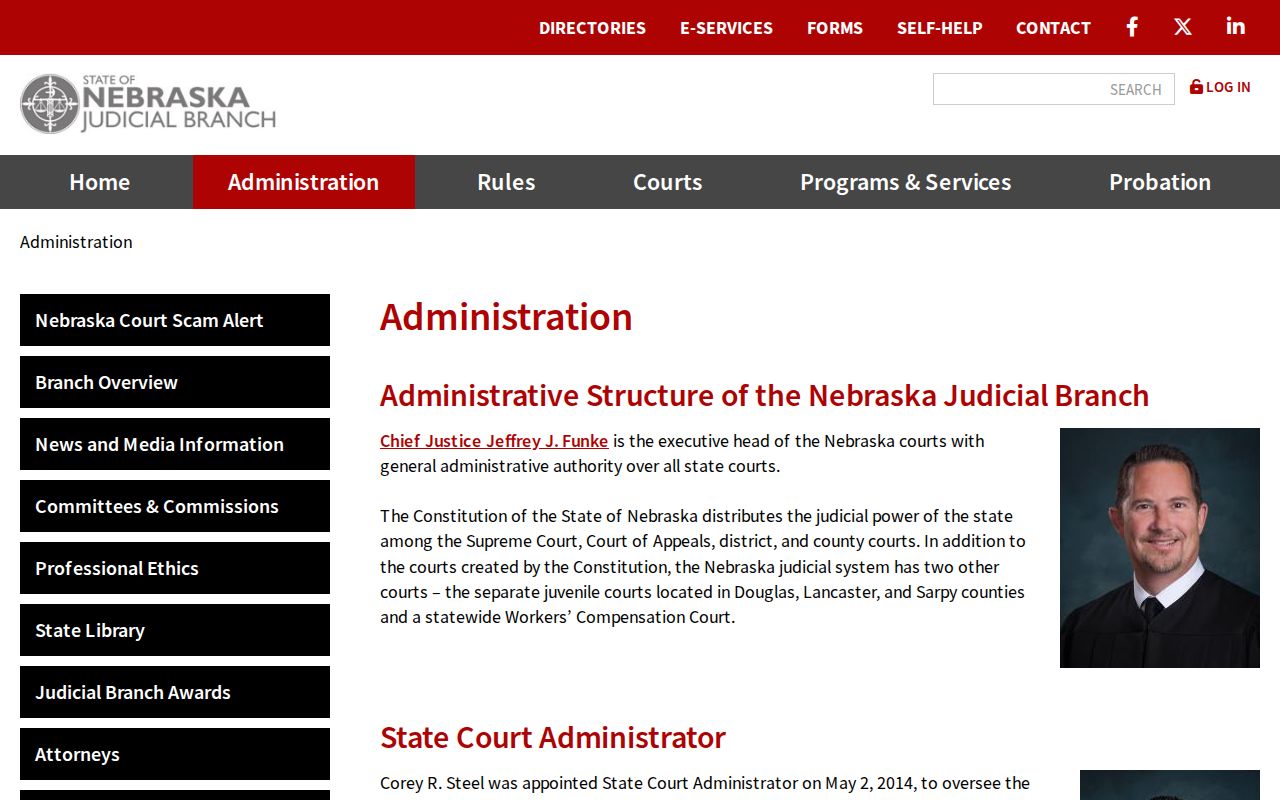
Statewide coordination comes from the administrator's office. The case file itself stays with the local clerk, who handles record-specific copy requests.
Nebraska's constitution gives the Supreme Court administrative authority over the judicial branch. That design lets system policy and technology be coordinated centrally, while filings, hearing settings, and certified copies remain tied to the court where the case is pending.
The Statewide Portal for Nebraska Cases
Nebraska Judicial Branch eServices points the public to JUSTICE, the trial-case system. The search reaches County Courts, District Courts, and the separate Juvenile Courts across all 93 counties, subject to access limits. A case detail can show the summary, parties, offense information, finances, the Register of Actions, judge notes where applicable, and links to most imaged documents. It is an index, not a scanned copy of every file.
| Search view | Current access | Coverage or limit |
|---|---|---|
| JUSTICE one-time name search | $17; up to 30 results for three calendar days | Trial-court party-name search; an absent result does not prove no case exists. |
| JUSTICE subscriber list | $100 annual account; general lists are free | Filter by name, court, case type, county, year, judge, or attorney. |
| Case detail | $2 to open; linked images add no charge | Shows case information and ROA; eligible images are not guaranteed for every filing. |
| Appellate case detail | SCCALES subscriber; $2 per detail | Supreme Court and Court of Appeals matters, separate from JUSTICE. |
JUSTICE search lists refresh nightly, roughly every 24 hours. Online images generally cover eligible documents filed or uploaded after April 16, 2008, not older paper records. Try Nebraska's statewide docket search first, then ask the Nebraska clerk for anything missing, old, or certified.
Note: JUSTICE’s name-search and case-detail charges cover search access; the clerk separately quotes paper copies, certification, delivery, and transcript costs.
Nebraska’s County Courts Keep Local Files
The statewide system does not take the county out of the record path. Local clerks keep case documents, update events, and answer archive and copy questions. Nebraska's 12 judicial districts group counties for judges and administration only. The files do not merge at one counter. In smaller counties, the county clerk sometimes doubles as District Court Clerk. That happens when no separate office exists. The Nebraska County Court directory routes you to local contacts.
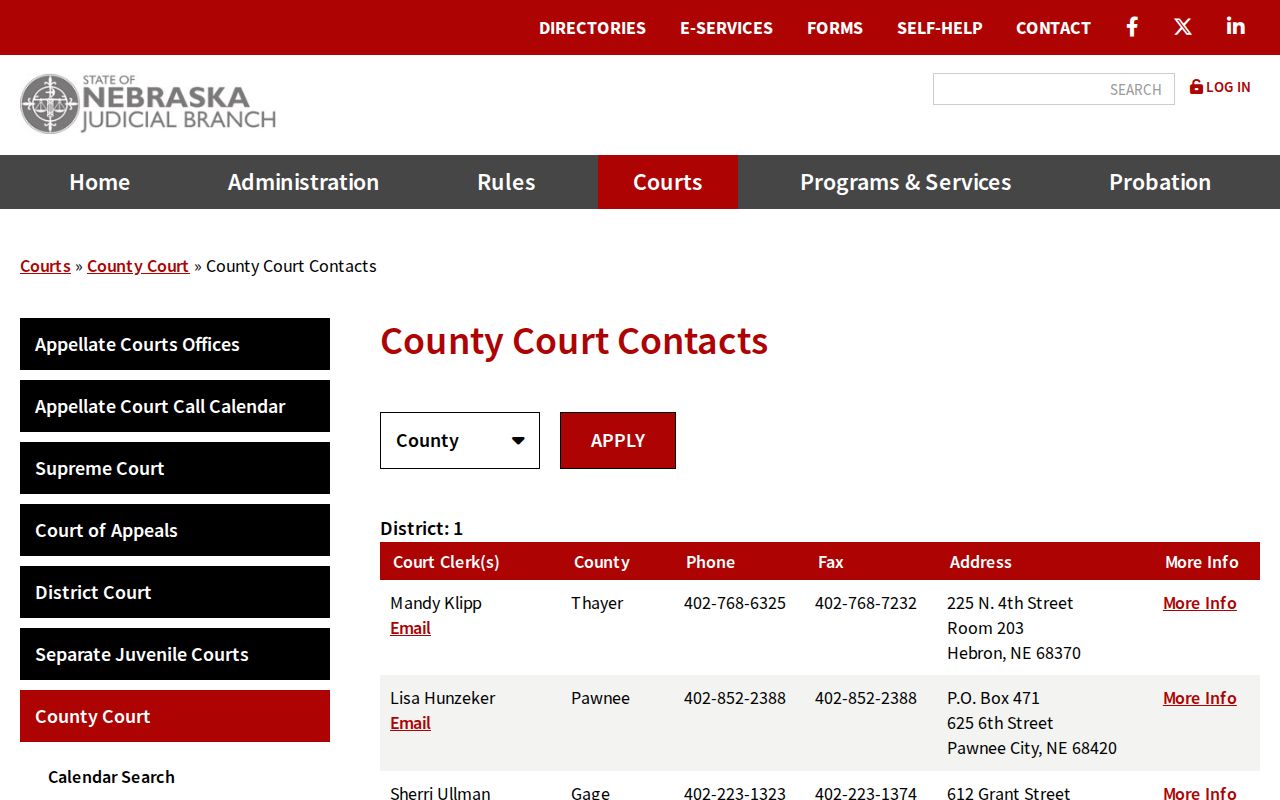
For felony, major civil, and domestic-relations matters, use the official Nebraska District Court clerk directory, or Browse Counties to find the right Nebraska court. JUSTICE covers every county, but staff and older archives stay local.
Nebraska's separate Juvenile Courts exist in only three counties. County Court holds juvenile matters everywhere else. A public JUSTICE result does not make juvenile filings open. Statute and case category decide what details are visible.
From County Docket to Nebraska Index
Every Nebraska case starts in its court of origin. The clerk there processes filings, records events and settings, and keeps the court's file. JUSTICE is the statewide trial system and public index, not the originating court. Attorneys file electronically through eFiling. Other filers follow the procedures that apply to them and their court.
Nebraska trial-case flow: Filing with the originating court › Clerk review and case entry › JUSTICE trial record › Public Nebraska.gov search
Gaps happen before public display. Clerk review, the nightly refresh, image processing, a confidentiality restriction, or an unscanned paper record can each leave a case invisible. If a Nebraska case does not appear, confirm the court and county, allow for the update, then ask the clerk whether the filing is pending, restricted, or held in another format.
An appeal follows a second path. The trial ROA may show notice and record preparation, while SCCALES tracks the appellate filings and decisions. Following the whole case can take both court levels.
SCCALES Keeps Nebraska Appeals Separate
Nebraska splits its systems. JUSTICE handles trial matters. SCCALES covers Supreme Court and Court of Appeals cases. SCCALES searches by appellate or originating trial number. It returns a case summary, parties, Register of Actions, and any final unpublished opinion or disposition. Published opinions sit in the separate, free Appellate Courts Online Library. The trial docket stays put, and the appeal adds its own briefs, arguments, and decisions. Article 8 of the Nebraska Supreme Court Rules defines public court-record access and its exclusions.
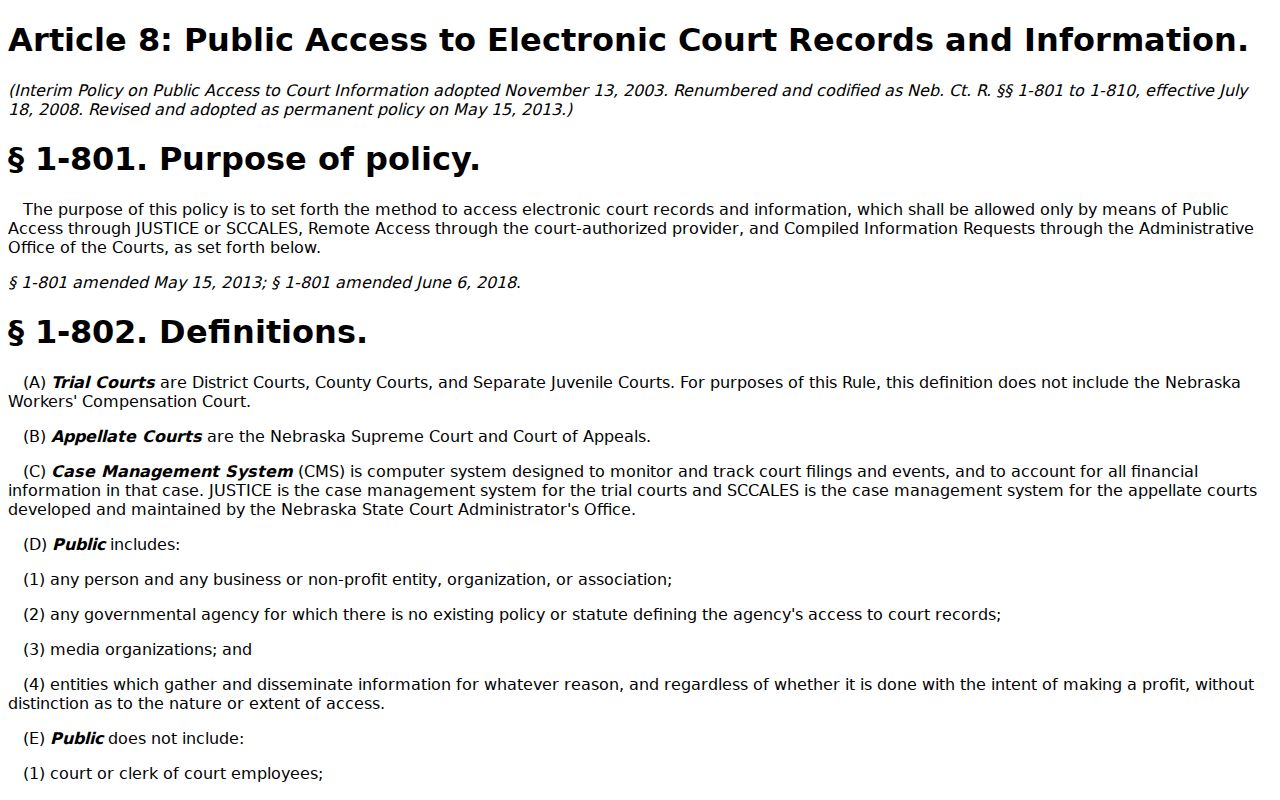
Nebraska's access rules draw real lines between public inspection, remote access, bulk data, and material that a law or court order seals. The SCCALES appellate search fits into that scheme. Case details there take a subscriber account. Opinions in the online library are no substitute for a full Nebraska appellate docket. A serious appeal watcher needs both. Federal cases never touch this system. An appeal from a Nebraska trial stays in state court and should be tracked in SCCALES as well.
Note: A published opinion may be available in the free library while its case detail remains behind SCCALES subscriber access.
How Nebraska Judicial Branch eFiling Feeds the Docket
The Nebraska Judicial Branch eFiling application runs through Nebraska.gov. It is where attorneys file into both JUSTICE trial cases and SCCALES appellate cases. It is a filing tool. Public search is not part of it. Attorneys submit a new case or a filing, and court staff process it. Mandatory eFiling for Nebraska attorneys has been in force since January 1, 2022, subject to rule exceptions. Self-represented filers may stay on paper unless a rule or order says otherwise. The official Nebraska trial eFiling login shows the authorized-filer sign-in route.
The Nebraska Supreme Court Chapter 2 rules govern submission, service, and notice. Filing charges are separate from any public-search fee. Once court staff process a submission, permitted data or images may surface in JUSTICE or SCCALES, though a filing account opens no doors to other people's cases. When in doubt, the clerk confirms whether a filing actually reached the case file.
Why a Nebraska Filing May Lag Online
A Nebraska filing rarely shows up in public search instantly. Court review, a nightly refresh, image processing, or a legal restriction can delay or limit what displays. A blank result means look closer. It does not mean no case exists. Double-check the Nebraska case number, the court, and the county, then pick JUSTICE or SCCALES and give the nightly update time to run. Still missing? Ask the Nebraska clerk about processing, a paper file, or restricted access, since older entries may never have been scanned.
Note: Nebraska’s statewide trial search covers all counties, but it does not promise same-minute updates or an image for every public filing.
Statewide Index vs Nebraska County Docket
JUSTICE is how you locate and follow a public Nebraska trial case. The official file sits with the local Nebraska clerk. The statewide index hands you summaries, ROA entries, schedules, finances, and links to eligible documents. For unscanned records, paper archives, certified copies, and clerk confirmation, the local file is the route.
| Question | JUSTICE statewide view | Originating court file |
|---|---|---|
| Where can a trial case be found? | Across County, District, and separate Juvenile Courts statewide | At the Nebraska court where the case was filed |
| What does the user see? | Case details, ROA, schedules, financial data, and most eligible images | Official electronic or paper file and local record history |
| What is not guaranteed? | Every image, instant refresh, or unrestricted case data | Remote access or a universal delivery method |
| Where to get a certified copy? | Not a certification counter | Ask the responsible court clerk |
Browse Counties points you to the originating court, and appeals add the appellate clerk and SCCALES as a second docket. Search locates the right Nebraska office; only the clerk supplies the official copy.
Nebraska Calendar Coverage Is Separate
The Nebraska Multi-Court Case Calendar is its own interface. It lists selected current and future hearing settings, not every case or date. Its own published warning flags District Court calendar omissions in 13 counties. JUSTICE, by contrast, covers statewide trial-case search across all 93 Nebraska counties. Two different services. Don't turn the calendar gap into a case-search gap. The official Nebraska Multi-Court Case Calendar can still help you find a public setting, but the newest case notice, any order, and the clerk or court coordinator are more reliable once a hearing changes. A calendar hit is not the whole docket. A calendar miss does not mean the case is absent from JUSTICE. Appellate and federal dates run through other channels. For a Nebraska trial case, use JUSTICE and the clerk for the history, then confirm the hearing against the latest notice.
How Nebraska Courts Went Digital
Nebraska’s official judicial history timeline marks the 1970 constitutional reorganization as the turning point. That shift gave the Supreme Court administrative control, added a State Court Administrator, and set up a uniform County Court. Justice-of-the-peace courts went away. The timeline does not record when JUSTICE first launched or when each older file was converted.
Digital access grew in steps. Attorney eFiling became mandatory in 2022. Document-image links became available in 2024 for eligible files dated after April 16, 2008, and public-library access reached all 12 judicial districts by FY2025. County Court limits changed in 2025, and Nebraska search fees rose January 1, 2026.
One more access milestone sits in the Nebraska Judicial Branch’s August 2025 announcement of its official web-address change, which spells out the new address for court docket services.
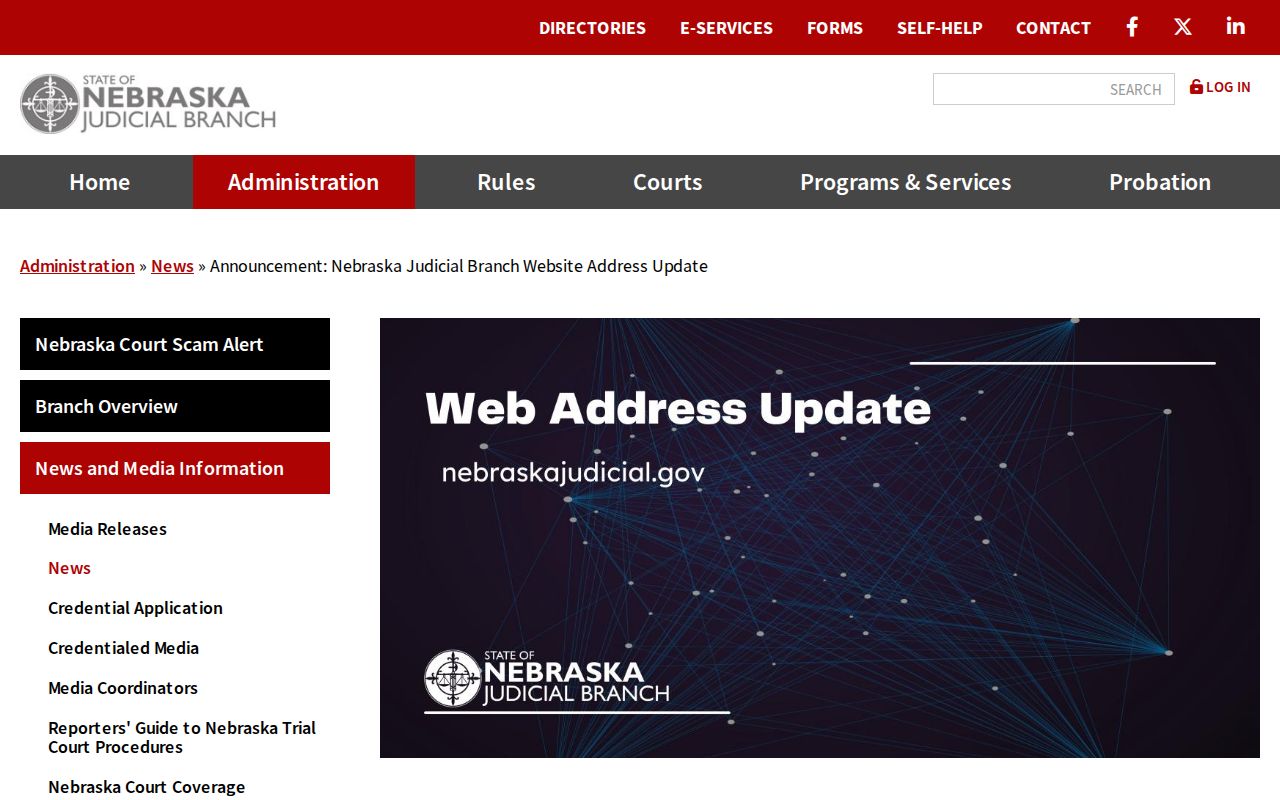
Since August 15, 2025, Nebraska Judicial Branch pages live at nebraskajudicial.gov, though older official links may redirect. JUSTICE, SCCALES, and the calendar remain three separate tools.
Note: The dated sources confirm Nebraska’s August 2025 website change, but do not establish the first JUSTICE launch or the conversion date of older files.
The 2025 Nebraska Court Jurisdiction Change
Where you file in Nebraska depends on the case type and the amount in dispute. Effective July 1, 2025, the state raised County Court civil jurisdiction and the small-claims limit. The new civil limit runs through June 30, 2030 and shapes where new cases may be filed.
The numbers matter. Small-claims jurisdiction rose to $7,500, while County Court civil jurisdiction climbed to $70,000 through June 30, 2030. County Court and District Court jurisdiction overlaps at the statutory threshold. The Nebraska Judicial Branch notice lists the effective dates.
Division of labor still counts for a docket search. Nebraska County Court handles traffic, misdemeanors, probate, and preliminary felony hearings, while Nebraska District Court keeps felony trials and the broader civil cases. Read the case caption before you choose a clerk or a search filter.