
Nebraska Criminal Docket Searches
Nebraska runs its public trial-court criminal search through the JUSTICE service. A defendant's name or a case number from a court notice is enough to begin. County and District Court records stay separate here. Confirm both the court and the county before assuming a result is the full history. The filed documents and the complete criminal docket stay with the clerk. That clerk is the court where each event happened. For older files, certified copies, or a question about one entry, that local clerk is the source.
On a name search, use the spelling found in the court record. Pick Individual rather than Entity. A middle initial can throw off matching if the file omits it. The one-time service searches by party name alone. A subscriber form adds filters. It covers court type, case type and subtype, county, year, judge, and attorney. For a misdemeanor or a preliminary felony event, search the lower court first. Then check District Court for the felony after bindover. A fuller walkthrough of the statewide lookup sits at Docket Search.
- Open Nebraska Judicial Branch eServices and choose the trial-court case search for a criminal matter.
- Enter the name or case number. Add the Nebraska county, court type and year filters when those details are known.
- Compare the Nebraska case caption and court level. For the full local docket, use Browse Counties to reach the originating county's clerk.
- Read the Nebraska Register of Actions in date order, then open the actual order or judgment image when available.
- Ask the clerk for an unavailable or certified Nebraska record, and confirm current hearing or warrant information with the responsible court.
Search Nebraska Criminal Cases in JUSTICE
JUSTICE is the case system Nebraska uses across all 93 counties. Every county takes part. You can reach it two ways. One is a one-time service built for a quick name lookup. The other is the subscription service. It lets you filter the statewide docket results. Both point to the same system, so neither is a separate county portal. The official Nebraska Judicial Branch eServices page lists both services. It explains which court records the public view returns. For context, the Nebraska County Court overview describes the lower trial-court level, where misdemeanors and preliminary felony matters are heard.
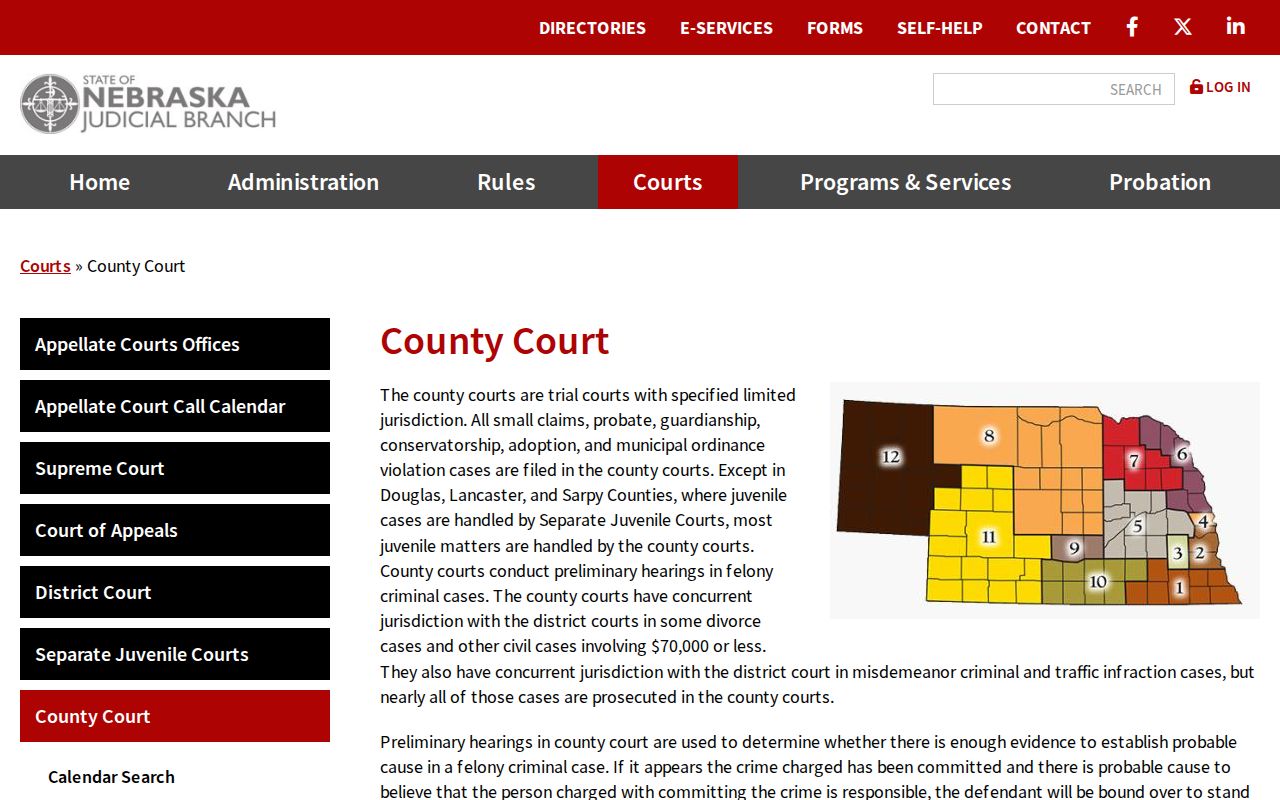
That overview helps you tell a County Court stage apart from a later District Court felony file. It is no stand-in for the case caption or the clerk record in a given prosecution.
| Search route | What it offers | Current access terms |
|---|---|---|
| One-Time Court Case Search | Party-name lookup; up to 30 returned records, with results available for three calendar days. | $17 per search. |
| Subscriber search | Free general lists with filters for name, court, case type, county, year, judge and attorney; open a case detail to review the ROA. | $100 annual account fee, up to 10 users; $2 per case detail. |
| Courthouse and law-library terminals | Free public access to JUSTICE where a kiosk or participating library terminal is available. | No online search charge at the public terminal. |
Nebraska's static help pages don't list every dynamic subtype, judge, or attorney option. Linked images add no separate charge to a case detail. What you get from a Nebraska search result is an index view, so certified copies and paper documents still go through the clerk.
Note: A free Nebraska courthouse or library terminal can be useful when online detail pricing is not practical, but local hours and participating sites should be confirmed before travel.
Inside a Nebraska Criminal Docket
Nebraska's public case detail follows a shared trial-court layout. The case summary names the court and gives basic status. Offense information, though, is a tab specific to criminal dockets. Parties and attorneys, the case schedule, financial activity, and the Register of Actions each sit in their own section. The Nebraska interface guide also lists Warrant Information, Court Costs, Payments Made to the Court, Judge's Notes, and Exhibit List tabs. Treat those labels as the areas the system can offer. They are not fields promised in every public case.
| Case number | The Nebraska trial format uses a C or D court prefix, a two-digit county number, case-type letters, a two-digit year and a sequence. A pattern example is C## CR-YY-######. |
|---|---|
| Case summary and offense information | Basic Nebraska case status and criminal charge information. The complaint or information is the filed charging paper. |
| Parties and attorneys | Names and roles associated with the Nebraska court case, subject to access rules and the detail shown for that record. |
| Case schedule | Case-specific hearing and proceeding settings, which may change as the matter moves forward. |
| Register of Actions | Dated filings, hearings and entered judge orders, including events shown in the Nebraska court's case history. |
| Financial and warrant tabs | Costs, payments and warrant-related information where applicable; neither tab alone confirms a current warrant status. |
Most documents filed in a Nebraska criminal case may show up as linked images, yet a public summary can exist with no image attached. A screen label is never the signed instrument itself. For a hearing date that matters, check the latest case schedule or call the clerk to confirm.
Where Nebraska Criminal Dockets Split by Court
A criminal docket in Nebraska moves between courts as the case changes stage. County Court handles misdemeanors, traffic prosecutions, initial appearances, and the early felony steps. After bindover, the felony trial docket sits in District Court. That court also takes many post-conviction matters. So an early entry may not sit under the same court or case number as the later trial file.
| Court level | Criminal docket focus | Record contact |
|---|---|---|
| Nebraska County Court | Misdemeanor cases, traffic offenses and preliminary stages of many felony cases. | County Court clerk or clerk magistrate. |
| Nebraska District Court | Felony prosecution after bindover, felony trial and many later proceedings. | District Court Clerk. |
All 93 Nebraska counties run both trial-court levels. What differs is the staffing. Counties at or above a statutory population threshold elect a separate District Court Clerk. Smaller counties fill the role through local arrangements. For any case you already know about, read the county and court printed on the notice. Then pick that clerk in the directory. No single statewide counter holds every Nebraska trial file, so the county is your starting point for a docket search.
How a Nebraska Criminal Docket Moves
A Nebraska misdemeanor usually begins in County Court, where the complaint gets filed. From there, the criminal docket can list an initial appearance, a bond decision, arraignment and plea, motion practice, later settings, and then trial or plea followed by disposition and sentence. A not-guilty plea often means another hearing date comes next. A guilty or no-contest plea may move things straight to a finding and sentencing. Every case runs its own sequence. Remember that a docket records events. It does not explain their legal effect, so an entry marked as a motion is a request and not a ruling.
Docket flow: Complaint or charge filed › Initial appearance and bond › Preliminary hearing when required › Bindover and District Court information for a felony › Arraignment, motions and settings › Plea or trial › Disposition and sentence
A Nebraska felony starts in County Court. There, a judge weighs probable cause at the preliminary hearing. Bind the case over, and an information opens a fresh stage in Nebraska District Court. That stage has its own arraignment, motions and trial settings. Probable cause can also fail. When that happens, the charge may be dismissed at this stage and refiled later. Tracking only a District Court case number hides the earlier County Court entries. The reverse holds too. The Nebraska judiciary's felony process explanation walks through this transition.
Reading Nebraska Criminal Docket Terms
Nebraska calls its chronological case history the Register of Actions, or ROA. It lists filings, hearings and entered orders in the order they happened. A line like “motion filed” or “warrant information” only points you to a record. Or it may point to a system tab. It does not hand you the signed decision or define every legal term inside it. When the wording is unclear, pull up the linked paper itself. The clerk can also tell you which document controls.
- Bindover
- The Nebraska County Court transfer that sends a felony case to District Court after preliminary proceedings.
- Disposition
- A recorded Nebraska case outcome or status event. Read the dismissal, judgment or sentence to confirm what the court ordered.
- Reset or continuance
- A proceeding moved to a later date. A reset is not a dismissal of the charge.
- Warrant Information
- A Nebraska JUSTICE detail area that may show warrant-related information; the issuing court or authority confirms current status.
A money line on a Nebraska docket is not a clerk receipt. And the ROA is not a hearing transcript. Nonparties who want a typed transcript of a trial or proceeding must first get the trial judge's permission through the Nebraska judiciary's transcript process.
Note: When an entry's short label leaves doubt about a ruling, request the signed order instead of relying on a paraphrase of the register.
Nebraska Courts With Criminal Dockets
Every Nebraska county has both a County Court and a District Court. Douglas, Lancaster and Sarpy Counties go further, running separate Juvenile Courts. Elsewhere in Nebraska, juvenile matters sit within County Court jurisdiction. Juvenile records carry their own confidentiality rules. An adult criminal search cannot tell you the whole juvenile file is public. Court and case type matter as much as the name you type in. That holds in any statewide docket query.
Need a juvenile file? Contact that Juvenile Court's clerk or administrator if the county has one. No such court? Start with County Court. Nebraska's state directory routes readers to local contacts.
Nebraska appeals land in SCCALES. It is a system separate from JUSTICE. It serves the Nebraska Supreme Court and Court of Appeals. Federal cases fall outside JUSTICE too and require PACER. The Nebraska trial docket alone will not show those later records.
Why a Nebraska Criminal Docket May Lag
Nebraska.gov describes the public JUSTICE result list as a nightly update. It carries roughly a 24-hour delay. After a paper is filed, the timeline can stretch further. Clerk review, a restriction decision, image processing or later system posting can each add delay. So a very recent Nebraska filing missing from the public index is not proof the court received nothing. Check the court listed on your notice. Confirm the spelling and case type. Call the clerk when timing matters.
The image window is narrower than the docket history itself. The Nebraska Judicial Branch says documents filed or uploaded after April 16, 2008 may carry linked images. It depends on the case and the upload. That does not mean every later paper was scanned, nor that earlier events are all missing. An older Nebraska entry can stay searchable. Its paper may sit in a local file, microfilm archive or another retention format.
Missing image on a Nebraska docket? Give the clerk the county, court, case number and event date. Ask whether the item is on paper, restricted, never converted or no longer retained. Remote search cannot pull up a record that was never imaged.
Note: A missing image, a delayed result and a sealed document are different conditions, so ask the clerk which one applies before drawing a conclusion.
Nebraska Criminal Docket Access Rules
Nebraska sets the rules for opening court records through its Supreme Court's access rules. State statutes and orders issued in a particular case also shape access. The Nebraska Public Records Act lays a wide baseline for government records. Yet a court rule, a sealing order, or a confidentiality statute still wins when the two conflict. So Public JUSTICE may show a Nebraska case while holding back a restricted document or a sensitive field. A caption you can see does not mean every page in that file is open. Anyone who asks will hit that limit.
Juvenile records in Nebraska get their own check. Statutes spell out exactly what may be shared. Adoption records are confidential. Some adult criminal records can also be sealed or removed when the law allows. No general request unlocks a sealed file.
Key Rules:
Nebraska Court Rules, Article 8, including Rule 1-808 - establishes public court-record access and excludes records made confidential by law or court order.
Neb. Rev. Stat. § 29-3523 - governs specified criminal-history and dismissed-case sealing or removal, subject to its conditions.
Neb. Rev. Stat. § 43-2,108 - limits access to confidential juvenile case information and lists authorized disclosure paths.
When a Nebraska court document is public but not online, ask the clerk at the court where the case was filed for a copy. Confirm the cost and format first. A sealed file works differently. Only someone authorized by the governing law or court order may seek access to it. The clerk can walk you through the Nebraska process. Whether you actually receive the record depends on the rule that applies.
Nebraska Criminal Docket vs State Patrol History
A Nebraska court docket and a criminal-history record are not the same thing. The docket in JUSTICE lists court events as they happen. Criminal-history files sit with the Nebraska State Patrol, under a separate set of access rules. So a Nebraska court result should never be treated as an official state criminal-history report.
One caution about warrants. A JUSTICE warrant tab or an old warrant event cannot tell you whether a warrant is active today. Check with the Nebraska court or authority that issued it. And for the outcome of a charge, read the signed judgment or dismissal itself. Do not just trust the "disposed" label.
Note: When you need to confirm an active warrant or the terms of a Nebraska sentence, contact the issuing court or authority rather than relying on a search summary.