
Nebraska ROA and Filed Orders
Nebraska's public case service calls its dated list of filings, hearings, and orders the Register of Actions. The short form is ROA. Treat the Nebraska ROA as an index of events. It names the motion, signed order, judgment, exhibit, or transcript. It is not those papers itself. When an entry carries a linked image, that image may be the filed document. Older paper items and restricted records often have no public image at all. Read the entry first to locate the document. Then ask the Nebraska clerk for the operative text if the image is missing or you need the official record.
An order entry in Nebraska only reports that an order was entered. The signed order itself states what the judge directed. A disposition label never substitutes for the judgment or dismissal. The statewide search locates Nebraska case activity. The court of origin remains the source for the official file and certified copies.
Note: A case-detail screen can show a public event while access to an underlying Nebraska filing remains limited by a rule or order.
Nebraska Court Record Requests
Nebraska Judicial Branch eServices is the door to JUSTICE. A one-time Nebraska name search runs $17. It covers up to 30 results, which stay available for three calendar days. Subscriber lists cost nothing, an annual account is $100, and a case detail is $2. Linked images add no charge. Keep in mind these are search fees, not copy or certification fees.
Free Nebraska access exists at courthouse kiosks, the Nebraska State Library, UNL Schmid Law Library, Creighton Klutznick Law Library, and participating JUSTICE for All libraries. You can also ask the County or District Court clerk in person, or phone the Nebraska court of origin to confirm mail, email, payment, archive, and hours. No statewide copy-request desk exists.
- Search for the Nebraska case by party or case number, then note the case type, court, county, and year.
- Choose Nebraska County Court for traffic, misdemeanors, probate, or small claims, and District Court for felony trials and major civil cases.
- Name the filing and copy type. Use Browse Counties to find the local court contact.
- Call the Nebraska clerk before visiting or mailing a request to confirm delivery and payment steps.
Appellate papers in Nebraska go to the appellate clerk. Compiled statewide data follows a separate rule process. JUSTICE lists refresh nightly, so allow about a day before a recent Nebraska filing appears.
Nebraska’s Clerk Depends on Court Level
Nebraska keeps trial records at the court that handled the case. Clerk roles differ by level. The Nebraska District Court Clerk holds felony, major civil, domestic-relations, and related District Court records. A Nebraska County Court Clerk or Clerk Magistrate maintains misdemeanor, traffic, small-claims, probate, guardianship, and preliminary-felony files. Douglas, Lancaster, and Sarpy run separate Juvenile Court clerks. Elsewhere juvenile jurisdiction generally sits in County Court. Some smaller Nebraska counties have no separate District Court clerk. The county clerk may act in that role.
| Record sought | First contact | Statewide view |
|---|---|---|
| Felony after bindover, major civil, divorce | District Court Clerk | JUSTICE trial search |
| Traffic, misdemeanor, probate, small claims | County Court Clerk or Clerk Magistrate | JUSTICE trial search |
| Juvenile case in three separate-court counties | Separate Juvenile Court clerk | JUSTICE, subject to access limits |
| Supreme Court or Court of Appeals matter | Appellate clerk | SCCALES |
Confirm the office through the Nebraska County Court directory and the District Court directory. A Nebraska search result does not prove the document you want was ever scanned.
Nebraska Court Record Types
A Nebraska court file can hold the initiating complaint or petition, an answer, motions, notices, exhibits, signed orders, a final judgment, payment records, and the Register of Actions. The mix varies with the case and the court. Nebraska JUSTICE detail pages may show a case summary, parties and attorneys, judgment information, warrant information where applicable, case schedule, court costs, financial activity, ROA, judge notes, or exhibit list. Not every tab appears for every Nebraska case. Restricted material may not display.
Remember the difference in kind. A case record organizes events and finances. An individual filing or order supplies the full text. Older Nebraska files may be electronic, on microfilm, or on paper. Nebraska County Court records carry their own statutory framework. A District Court record statute does not govern every court file.
Nebraska JUSTICE Image Limits
Nebraska's statewide service says most filed documents can be opened as images, and the eligible set begins with papers uploaded or filed after April 16, 2008. That date promises nothing. A later Nebraska filing may never have been scanned. A record can be searchable without a document link. A paper file may lack an online image entirely.
When an image is absent, check whether the filing is older, restricted, still in clerk processing, or simply outside the set of documents uploaded to the case system. Ask the Nebraska court of origin to search its paper or microfilm holdings. Then ask about the retention path. The statewide case index is not a complete scanned archive, and a missing image does not establish that the filing never existed.
Note: The Nebraska clerk can confirm whether a record remains in a paper archive, has been destroyed under a retention schedule, or is restricted from public display.
What a Nebraska Court Record Holds
Use the Nebraska case number and event list first. It orients a request for the source document. Nebraska trial numbers commonly show a court prefix, county code, case type, year, and sequence. Older files may differ. Common prefixes include CI for civil, CR for criminal, JV for juvenile, PR for probate, SC for small claims, and TR for traffic. The field names here describe common file parts, not a live case.
| Case number and caption | Identifies the Nebraska court file, county, case category, and named sides. |
|---|---|
| Register of Actions | Dated entries for filings, hearings, and entered orders; not the text of each paper. |
| Pleadings and motions | Complaints, petitions, answers, and requests asking the court to act. |
| Orders and judgment | The signed or entered ruling that states the court’s direction or outcome. |
| Schedule and finances | Hearing settings, costs assessed, payments, and related case-detail fields when available. |
| Images and exhibits | Linked copies of eligible filings or exhibit information when public and uploaded. |
The Financial Activity field inside JUSTICE is neither a clerk receipt nor a driver record. Some protected details never appear in a public Nebraska entry. When you ask a Nebraska clerk for a specific document, give the filing date or the event tied to it.
Nebraska ROA, Orders, and Transcripts
Copies come in three grades. A plain copy simply reproduces an item. A certified copy carries the Nebraska clerk's assurance that it matches the official court record. A transcript is different still: a hearing record typed by an authorized Nebraska court reporter. A case-search printout is never certified. The $2 JUSTICE detail charge buys data, not a transcript.
Call the reporter with the proceeding, the date, and the portion you need. The reporter quotes the cost, and expedited work can run higher. Parties and attorneys may request a typed transcript directly. A nonparty usually needs the trial judge's approval, and hearing audio is not always downloadable.
Note: Request the signed order from the Nebraska clerk and a hearing transcript from the reporter; neither is created by printing the ROA.
Court Record Fees in Nebraska
Copy charges in Nebraska turn on the court and its fee authority. What a County Court charges is not a flat District Court quote. Postage or local handling can add to the bill. Ask the Nebraska clerk for an itemized estimate before you commit. Copy charges are one thing. Filing fees and reporter quotes are separate. The Nebraska Judicial Branch filing-fee and court-cost schedule posts the official numbers for current court charges.
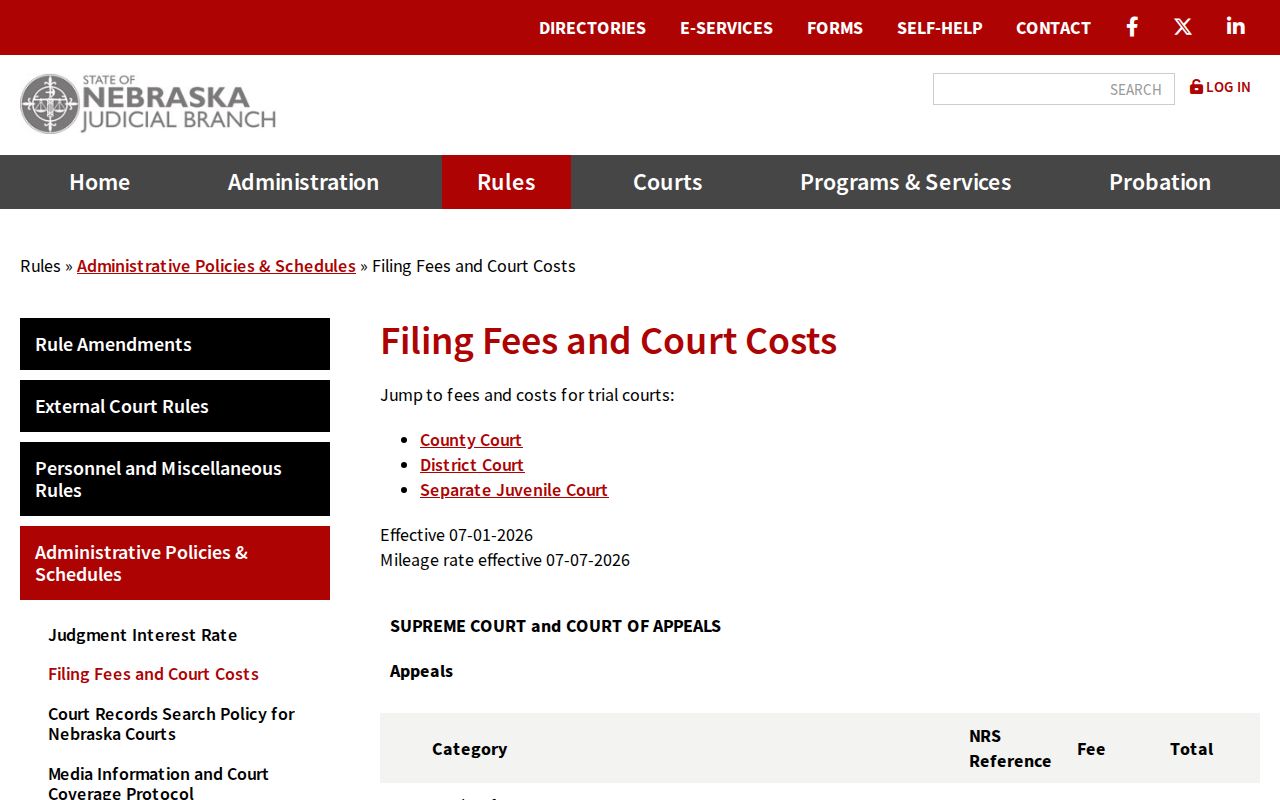
The schedule separates filing costs in Nebraska courts from the distinct charges for copies, certification, delivery, and transcripts.
| Record or service | Published amount | What to confirm |
|---|---|---|
| Nebraska County Court plain copy | $0.25 per page | Rate under Neb. Rev. Stat. §33-126.05; confirm local payment and delivery. |
| County Court certified copy | $0.25 per page plus $1 per seal | Shown on the County Court copy invoice; ask the clerk to total the request. |
| Certified public record under §25-1280 | $0.30 per 100 words or actual mechanical-copy cost, plus $1 certificate | Different statutory basis under Neb. Rev. Stat. §25-1280; do not substitute it for the County Court per-page charge. |
| Typed transcript | No uniform per-page rate located | Reporter provides an estimate; rush work may cost extra. |
Postage, media, and accepted payment methods vary across Nebraska courts and can shift your total. Always ask the court holding the file for certification.
Nebraska Has No Universal Request Form
When you ask a Nebraska court for a copy of a case file, you write the request yourself. A clear letter works best. Name the court, the county, the case number if you have it, the parties, the record you want, and the date or event involved. The Nebraska Court Records Search Policy sends a misdirected request to the State Court Administrator, but Nebraska keeps no statewide request form and runs no central copy desk. One county document trips people up: County Court Form CC 3:30. That is an invoice, filled out after the clerk has already made your copies, so do not treat it as a request form.
For a sense of how one local office handles it, the Lancaster County District Court Clerk Records Request form shows a single county's process.
That Lancaster form gathers a lot. It wants requester details, case and party identifiers, the document, the case type, a delivery choice, and whether certification is needed. Its two-business-day promise means a reply, not finished work. Email-certified copies go only to parties or attorneys. Paper runs $0.25 per page plus possible postage, and certification starts at $1. Other counties follow their own steps.
The Nebraska Public Records Act generally demands an answer inside four business days. That answer means access, an estimate, or a written denial. A request can be complex or voluminous. Then the custodian must explain the delay, give the earliest availability plus an estimate, and allow narrowing. Those rules still bend to Article 8 or a sealing order. Single-file requests follow Nebraska court procedures. Compiled data follows Rule 1-807. Note: A broad public-records request can overlap a case-file request. Ask the clerk which rule governs the court record.
Nebraska Record Access and Sealing
Access to a Nebraska court record depends on its category. So does the rule or statute attached to it. Article 8 controls court-record access through JUSTICE and SCCALES, public terminals, and compiled-information requests. The Public Records Act is a broad government-records law. It is no substitute for the judiciary's own access rules. A public case number can sit beside restricted filings, redactions, or a sealed document. The number alone tells you little.
Key Nebraska access rules:
Nebraska Supreme Court Rules §§1-801–1-810, Article 8 set the court-record access framework, including remote access, compiled data, and exclusions.
Neb. Rev. Stat. §§84-712 through 84-712.09 establish general public-record inspection and response rules subject to court-specific law and other exceptions.
Neb. Rev. Stat. §29-3523 governs sealing or removal of specified criminal-history records; eligibility and statutory conditions matter.
Nebraska Juvenile and Sealed Files
Adoption records in Nebraska are confidential under §43-113, and juvenile files carry protections under §43-2,108 and court rules. The category and its rule decide what shows. Not every juvenile entry is hidden, and not every filing is open. No Nebraska clerk may release a record against the law or a sealing order.
Under §29-3523, qualifying adult records can be sealed or pulled from ordinary public display, depending on disposition, date, and statutory conditions. Some records need a motion first. An eligible person seeking a sealed copy may use form DC 1:12 with its instructions, filed through the originating clerk and supported by identification. That does not reopen the file to everyone else.
An unsealed image that is missing? Ask the clerk for the file. For restricted records, establish your authority first. Use Browse Counties to locate the originating Nebraska court.